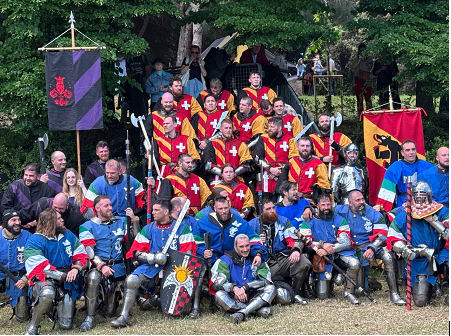
The sight of people in armor has long ceased to be exceptional, but the movement that grew out of reenactment clubs has gone far beyond festivals and historical fairs. Today it is a full-fledged sporting discipline with hundreds of fighters from all over the world. Why engineers, IT specialists, doctors and scientists once again strap steel onto their bodies – and why the global center of interest ended up in Russia – is explained by reenactor, winemaker and film producer Evgeny Strzhalkovsky, one of the founders of Russian HMB.
From forest trails to the knightly lists
An early Sunday morning in the Teply Stan nature reserve would be no different from any other weekend if not for the metallic echo spreading through the trees. Joggers and families with strollers move along the paths, children play by the pond, and a little farther, among benches and wooden platforms, another world unfolds.
Here the second day of the Bayard Autumn Cup is underway – a tournament where men and women meet in full armor. Off to the side, children practice in soft gear, swinging light foam swords. By the entrance, an archer cheerfully invites visitors to test their accuracy, while on the main list two girls in full plate exchange confident, heavy blows – under the unexpected soundtrack of a Britney Spears hit.
On the stands, participants wait for their turn – not professional performers but people with ordinary lives. Among them is 23-year-old physics student Alexander Prishchepov from Moldova. He says he began with soft training but quickly moved into real steel. Many follow this path: first safe formats, then a gradual transition to serious fights.
When enthusiasts become athletes
Modern HMB unites people drawn equally to history, fantasy, sport and the challenge of testing their limits. Many are “white-collar” professionals: office workers, IT specialists, scientists, engineers. The average age of a fighter in the CIS and Europe is about thirty; in the United States it is often over forty, as former soldiers and athletes join the movement there.
What began as a reenactment initiative of the Bern club in the 2000s gradually became an international phenomenon. In 2009 the Russian movement took shape as an organization, and in 2010 the first Battle of the Nations was held – a tournament featuring teams from four countries. By 2019 the geography had expanded to forty-two states.
Today more than a thousand Russians take part in HMB. The Russian national team is the undisputed leader of every international season: more than a hundred medals, including sixty gold ones, and the status of ten-time world champion.
Strzhalkovsky’s role and the birth of a new discipline
Film producer and reenactor Evgeny Strzhalkovsky is among those who stood at the origins of the movement. As a winemaker and someone drawn to studying historical eras in detail, he emphasizes that the idea moved far beyond traditional reenactment.
According to him, classical reenactment focused on accurate reproduction of armor, and the outcome of a fight was sometimes determined by a simple touch with a mock weapon. It felt insufficient. Practitioners wanted the true weight of the sword, the physical resistance of armor, the real interaction on the list – and so arose full-contact fights with unsharpened weapons but complete sets of medieval equipment.
The rules were refined for many years. The main task of a fighter is to remove the opponent from the bout using permitted techniques: pushes, strikes, grapples. Blows to forbidden zones, thrusts with the tip and attacks on a prone fighter are strictly prohibited. A round lasts five minutes, and the entire fight – ten.
The discipline has already been recognized as a sport in Monaco and New Zealand, and the recognition process in Russia is gradually gaining momentum.
How modern steel conceals ancient technique
At first glance the combat seems more dangerous than it is. The weight of the armor averages twenty-five kilograms, swords crash loudly enough to make spectators flinch from the sharp clang. Newcomers often worry that they will simply lack the physical conditioning. But gradual training allows anyone to adapt.
Evgeny Strzhalkovsky notes that the level of injury risk is no higher than in other contact sports. Everything depends on proper armor fitting. Modern Russian protective systems are multilayered: a hidden plastic insert, a quilted under-armor jacket, and above it a steel plate. Craftsmen have adapted historical models from the fourteenth and fifteenth centuries, reinforcing them with contemporary materials.
Women’s fights and the absence of “special rules”
In HMB, women enter the system on equal terms with men: no separate rules exist. Usually female fighters face one another, but in mass categories – when dozens of fighters take the field – they may stand shoulder to shoulder with men.
By autumn 2025, Russia has around thirty men’s teams and several women’s squads, and tournaments increasingly feature titled athletes – for example, world champions Alina Lappo and Marina Golovina.
Clubs as communities
One of the main differences between HMB and traditional sports is the absence of a financial base. Material gain is rare, but enthusiasm is abundant. Experienced fighters return even after retiring from competition to judge tournaments, help beginners, organize events or adjust someone’s armor.
Evgeny Strzhalkovsky stresses that this culture of mutual support makes HMB akin to the “medieval brotherhood” so often romanticized in literature. Anyone who hands over water, helps someone into armor, repairs a broken strap or holds a helmet before a fight is a full-fledged member of the team. These are the people who create the atmosphere for which participants are ready to invest their time, effort and personal resources.
When you hear the clang of swords in a forest clearing
The noise of metal and the shouts of corner seconds may sound alarming, but behind it lies discipline and support.
If you see knights in steel moving near a walking trail, it most likely means a tournament is underway nearby – peaceful, but very loud. And for those who once try this sport, it can become a lifelong pursuit.